Drinking in the 1950s: Penrith pubs and the absurd licensing laws

There were five pubs in town and one down by the river in the days when places to drink were very basic and drinking laws and customs were restrictive and, to say the least, bizarre. More on that later in this story.

This is not a large number of hotels for a town of this size, there were more in the old days. The Nepean Times reported in its issue of 30 September 1948 that in 1860 Penrith had eight hotels, as well as two banks, two schools and a couple of Masonic lodges. Must have been some heavy drinkers back then.

The pubs provided the only real accommodation in town. There were no accommodation-only hotels or motels in Penrith for a long while. Visitors to the town and travelling businesspeople had to stay in a pub or a boarding house. The hotel accommodation was generally room-only with a shared bathroom or two down the hall. No air-conditioning and the heating would have been electric radiators and hot water bottles.

The pubs had dining rooms to cater for their guests and these were also open to the public. Meals would have followed Australia’s dining habits at the time – soup, stews, meat with vegetables – beef or lamb (the price of poultry was prohibitive) – and unimaginative salads – ham salad, cheese salad, egg salad. And puddings, A pot of tea and slices of buttered bread were mandatory.

They also served traditional pub counter lunches rather than the trendy dishes served up today. A request for a roast pumpkin salad or buttermilk fried chicken would have been laughed at.

The hotels also did good business as a place for holding meetings. There were no convention centres or function rooms in the town other than a couple of rooms at the School of Arts in Castlereagh Street, or the Railway Institute near the station.

Most of the pubs advertised weekly in the Nepean Times and had their own little catchphrase, some of which in retrospect seem not only quaint but raise the question of why they needed to phrase it that way. It is surprising that the pubs advertised so regularly as nobody in the town would be ignorant of their existence and where they were, and they never had specials to advertise. Maybe the advertising was directed at out-of-towners.

The Top Pub (still there)

The Penrith Hotel in High Street, just down from Evan Street, popularly known as the Top Pub (top of High Street), was also known as Levy’s, after a previous owner. It was popular with police and the legal crowd, Both the police station and the courthouse (before it was rebuilt in Henry Street) were close by.

Teachers drank there too. If you walked past the pub after four o’clock and looked in the windows fronting the lounge, you could usually spot groups of teachers relaxing after a day at school. And who could blame them? They had little help from the Education Department and their only teaching aids were a blackboard and a piece of chalk.

Even after the courthouse moved, the hotel remained popular with the legal eagles, although it did lose some custom to the Australian Arms which was now closer to the courthouse than it had been.

One foolish licensee lost even more trade when Penrith’s hardest-drinking professional man, who had many hard-drinking mates, complained that he had been given change for a ten when he had handed over a twenty. Being drunk, he was probably wrong but instead of the licensee taking the long-term view of not offending a good customer, he refused the customer’s complaint. Result? The man and his mates never came to the Top Pub again. Revenue lost? Thousands.

In the fifties and early sixties, the host was Jock Bellis, a popular man and shrewd business operator who would never have made such a stupid mistake.

The advertising slogan for the Top Pub was ‘modern lounge and beer garden. Beer pulled under latest chilling conditions’.

The Arms (still there)

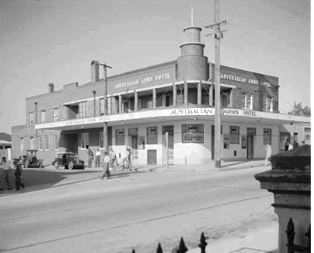
The Australian Arms was on the corner of Lawson Street which had been renamed from Castlereagh Street because it made no sense to Council to have the two arms of Castlereagh Street so separated.
the arms 2
The Australian Arms in earlier days (Max Dupain)

The Arms was the pub of choice for bank and clerical workers as a lot of banks and offices were up that end of town. Tradies too enjoyed the beer garden at the Arms and the ease of parking in the side streets.

There was a big paddock between the Arms and Dr Uren’s surgery in High Street where carnivals and fetes were held. This provided added custom for the Arms.

The Arms’ advertising slogan? ‘A first-class dining room’.

The Federal (gone forever)

The Federal was on the north side of High Street between Woodriffe and Station Streets and its customers were the working men of Penrith. It closed in 1976 to the dismay of its many regular drinkers.

federal hotel korna parr
The Federal (Lorna Parr)

The Federal’s newspaper motto was ‘all liquor true to label’. Whether this was an apology for past transgressions or a dig at the other hotels, I do not know.

Tatts (still there)

TATTS AD

Tattersall’s Hotel was on the corner of Station Street and High Street (south side) and is still around there. Its ads in the fifties boasted of ‘only the purest liquor sold, hot and cold water lock-up garages’.

Good to know that they had hot water for a bath but, like the Federal’s motto, the statement that only the purest liquor was sold is a bit of a puzzle. Perhaps the ad was suggesting that other Penrith hotels were in the liquor-diluting business. Who knows?

The CTA in the ad alongside presumably stands for the Commercial Travellers’ Association.

Tatts was a popular spot for meetings of sporting bodies. This may be because of its links with the famous footballer Dally Messenger. Apparently, Tatts was started by a relative, Charlie Messenger, in the late 1890s. It was named Tattersalls after the racehorse yards in England or possibly to give it some association with Tattersalls Club in Sydney.

Mrs Morrison was the licensee for many years.

The Red Cow (still there)

The Cow was and is a landmark in Penrith, as much for its name as anything else. In an era when pubs mostly had unimaginative names like The Royal Hotel, the Commercial Hotel and so on, the Cow had a descriptive name of the kind that you found in English pubs and the trendy drinking spots of today.

red cow 2
The Red Cow, probably in the late 19th century

As I understood it, the Cow was built around the time that the railway came to Penrith sometime in the 1860s and was known variously as Smiths Hotel after the man who built it and the Railway Hotel – naturally. It had always had a beer garden. It was popular with railway workers and particularly train travellers, getting in a last one before going home.

The Cow’s ad told us that it had a sleeping out verandah and was sewered with electric lights throughout. It also boasted a cool beer house, whatever that meant.

The Cabin (gone and back again)

I loved the Log Cabin and had many pleasant Friday nights and Sunday afternoons there in the lounge, enjoying a live band or just the jukebox.

log cabin
The old Log Cabin (G’day pubs)

Situated as it was on the banks of the Nepean, it was a popular pub for both residents and tourists. It was always packed on GPS Regatta day.

Again, I understand there had been inns or hostelries in that general area since the early days of Penrith. The Cabin started out as a tea room called the Log House. The story is that it was built by a wealthy Sydney businessman who became irked when he could not get a decent cup of tea when travelling from Sydney to the Blue Mountains. It was later extended and became a licensed hotel with accommodation of a generally higher standard than available elsewhere.

Frank McKittrick bought the place in the fifties, upgraded it and added motel-type rooms but the pub was to all intents and purposes run by Miss McCredie, a tall and angular woman. If you were a really good customer and Miss McRedie liked you, she might let you doss down on a lounge in her office if you needed time to sober up before driving home.

The pub burned down in 2012. A great pity.

I understand that the Log Cabin has come back. That is good news but, for me, I doubt whether it will recapture those boozy Friday nights and Sunday arvos with our gang dancing to the jukebox in the lounge.

The bizarre drinking laws and customs way back when

Let’s start off with the customs. Until the liberation of the sixties, women were not allowed in the public or saloon bars of hotels and could only drink in the ladies’ lounge. Preferably not alone or too frequently to avoid getting a ‘reputation’. Popular drinks amongst women were shandies (beer and lemonade), brandy crustas, advocaat and cherry brandy cocktails (ugh!), and Pimms No 1 Cup.

Almost all pubs were ‘tied pubs’, that is they were either owned by one of the two breweries (Tooths and Tooheys) and leased out to the licensee or the licensee had an exclusive arrangement with one of the breweries. The consequence of this was that a tied pub sold only Tooths or Tooheys products and not both. If you were in a Tooths pub and wanted Tooheys New, bad luck. You would need to find a Toohey’s hotel.

This monopolistic arrangement and the absence of women from the public bars of hotels meant that there was no real motivation to make the male drinking areas attractive – tiled floors, noise and a cloud of tobacco smoke made up the ambience. Frankly, the Ladies’ Parlours were not all that much better but they were generally carpeted.

Millers, a new brewery opened for business in, I think, the early sixties, built some hotels and made a genuine effort to make their bars presentable, if overly garish. A nauseatingly blue carpet and rotating chandeliers seemed to be standard.

This together, with the increasing admission of women into hitherto exclusive male drinking areas and the introduction of anti-monopoly laws, forced the existing pubs to lift their game in order to compete for customers and improve the appearance and environment of their bars.

The drinking laws and the six o’clock swill

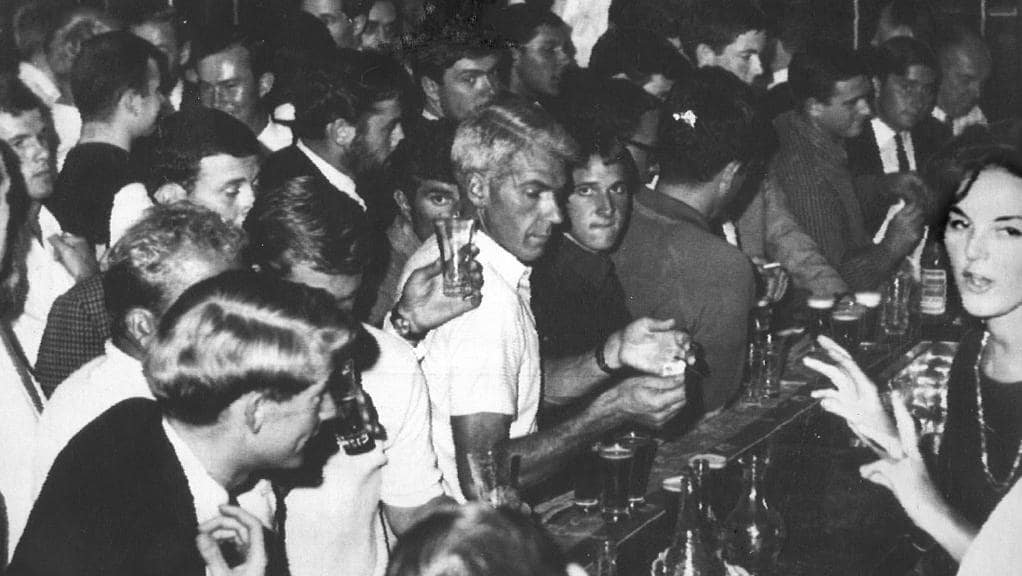
Until 1955, pubs in New South Wales had to close at 6 pm. This led to the famous ‘six o’clock swill’ where drinkers tried to get as many drinks in before the pub closed. This was particularly inconvenient to Penrith people who worked in Sydney because by the time they finished work, there was little time to drink in a Sydney pub and by the time they got home to Penrith the hotels had closed. The Chips, for example, left Sydney at 5.24 pm and did not get to Penrith until after 6.
six oclock swill
A six o’clock swill

The laws were then liberalised and pubs were allowed to trade until 10 pm but to appease the temperance lobbyists there was a compulsory meal break between 6.30 pm and 7.30 pm during which time the pub had to close its doors. Although this made no logical sense, it meant that Penrith commuters could get a drink after they arrived at the Penrith train station, even if they had to wait a few minutes. It was not uncommon to see suited train travellers waiting outside the Red Cow for the doors to open at 7.30.

After several years, the compulsory meal break was abolished.

The nonsensical Sunday drinking restrictions

Even more absurd were the restrictions on drinking on Sundays. For some years, you could not buy a drink in a hotel on a Sunday unless you were a ‘bona fide traveller’. A bona fide traveller was someone who lived a certain distance from the hotel, I think 30 miles (50 kilometres).

So, even in a time when the dangers of driving after consuming alcohol were well known, the powers that be thought that it was okay to encourage people to get in a car, travel to a distant place, have a few drinks and drive back home.

Of course, the silliness of this law meant that nobody took any notice of it. Local residents would go to their local, sign the register that licensees were required to keep, give a friend or relative’s address outside the zone as their place of residence (or make one up) and then go in for a drink. It was pretty amusing to watch the local licensing sergeant walk into the lounge at the Log Cabin on a Sunday to check the register and greet drinkers by their first names.

Thankfully, this restriction too soon passed into history.

.

Pubs in the past 

Penrith has been served by drinking establishments almost since its founding – inns, hotels, and sly grog joints. Lorna Parr of Penrith Council has written a really good story on these early drinking spots.

The Commercial Hotel

Riverside Inn
Today’s pubs

Penrith’s remaining pubs from those years – the Top Pub, the Arms, the Cow and Tatts -are now vastly different to what they were in the forties and fifties, external appearance aside. These hotels now are modern, well turned out, have a variety of entertainment and stock a range of beers that earlier drinkers could never have even dreamed of.

And – shock, horror! There are women in the bars.

Penrith High School in the 50s (7): school dances

School dances were usually held at the end of each term – three terms only then, so three school dances a year. Sometimes an extra dance was put on by the Parents and Citizens’ Association.

The dances were organised by a student’s committee and a student performed the MC role, although occasionally a teacher took over this job.

How we got to the dance

None of us had cars. We couldn’t have afforded them even if we were old enough to drive, which we weren’t. Those of us who lived locally would have walked to the dances and then back home. I don’t know how the students from outside the town got there. Probably they were either driven by a parent or perhaps the school put on buses.  This rather limited the romantic opportunities, although some managed to overcome the difficulties.

Riding a bike to the dances was really just a self-acknowledgment by a boy that he was unlikely to be escorting a girl home after the dance. He might get lucky but walking a girl home while wheeling a bike isn’t exactly romantic. Of course, he could always double her but taffeta frocks and bicycles didn’t mix all that well.

This transport situation also presented difficulties for boys actually taking a girl to the dance. The lack of a car meant, unless a parent or older sibling was prepared to drive them, that the boy had to walk to the girl’s place and then walk with her to the dance. And then back home again. This was okay if you lived within a reasonable walking distance but if say the boy lived in Evan Street and the girl lived in Ladbury Avenue down near the river, a lot of footwork was involved. That carefully chosen mandatory orchid corsage would be drooping on a hot night.

The walking alone was enough to dampen the ardour.

Chaperones of course

The dances were held in the hall and they were very heavily supervised with adult eyes kept wide open for such major sins as alcohol, smoking, and couples leaving the hall for more secluded areas.  It is hard in retrospect to see why the teachers went to so much trouble because we were pretty naive by contemporary standards and few of us were sexually adventurous and not many of us drank.

The sin of choice was smoking which was carried out well away from the teachers. Down near the oval was the preferred spot, although there was always the chance of a teacher making a surprise raid.

I don’t remember if the tuck shop was open on school dance nights and the need for hydration was not then well-known. Water was available from the outside bubblers but on occasions, a particularly nasty fruit punch was served up. It tasted like it was concocted as an experiment in the science laboratory.

Keeping out the ex-students

A couple of male teachers would attend the doors as bouncers. Mr Dillon, the deputy head after Deserthead Eason left, fancied himself as an enforcer. The teachers were concerned not so much with keeping current students in as with keeping predatory male ex-students out. Ex-students were prohibited from attending school dances unless they were given special permission to attend.

I don’t think they needed to bother. The teachers had very good recognition skills and could always spot an intruder and if an ex-student had managed to get in, I am sure that a cold stare from Miss Baldwin or Miss Butt would have sent them scurrying back out again.

Dancing with the stars – sort of

At this stage, rock music was only just getting started. Rock around the Clock came out in 1955 and the ‘devil’s music’ as they called it was not received enthusiastically by either parents or teachers. The dancing and music prescribed for the school dances reflected what was then acceptable to the community – a nice rhythm with not too much noise or too much beat.

On the dance floor, the showstoppers were The Pride of Erin, Jazz Waltz, and the Two-step. The more accomplished hoofers could do the Quickstep. The Progressive Barn Dance was always on the dance menu and this gave an opportunity for those boys who couldn’t get a girlfriend to at least get their arms around the girls of their dreams for a minute or two.

fredandginger
Fred and Ginger would have been asked to leave

Jiving was frowned upon. Rock and roll dancing was a year or two in the future.  Twist? Stomp? Watusi? Disco dance moves? Not yet invented and would not have been allowed.

Most of us, except for those who had gone to dancing lessons, just stumbled around the dance floor. Our best hope was that the girl knew how to dance and would take the lead to avoid having her feet mauled.

Ballroom dancing classes for those who wanted to fancy foot around the boards to impress the opposite sex were run by Kevin Jones and Mrs Jones, both former professional dancers, on a Thursday night. They were private and not a school thing.

As the dance drew to an end, there was always a final dance to slow music. Miss Baldwin and the other chaperoning teachers were right on the spot to see that all hands were where they were supposed to be. Miss Baldwin probably had a set of vernier calipers in her pocket to measure the distance between a couple to ensure they were not too close.

The music

Sometimes the music was supplied by outside bands, like Pinsons Dance Band from Springwood or Max Upton’s Orchestra. The latter was a popular band for dances and balls in Penrith. I don’t recall the makeup of these bands but they would not have been all that exciting

The school also had its own band or orchestra as it was more properly called which sometimes provided the music. It was just the right combo for the type of dancing that was allowed. There was a violin (Fay Kirkness, I think), piano (James Short), and a saxophone (Ian Smith). John Davies played the drums. The band could have done with a lead guitar, a bass and some amplifiers but Elvis was a year away and The Beatles were still going to school themselves.

netherfields ball black white
Not quite a Penrith High School dance

Changing times

Looking back, with the boys lining up on one side, trying to gather up some nerve, and the girls on the other side, dreading that the wrong boy would approach them, those school dances were a bit like a Jane Austen country ball but without the crinolines and the breeches.

Of course in a patriarchal society, it was not done for a girl to ask a boy out or even for a dance, so the girls would have been anticipating the Ladies’ Choice announcement when it was actually okay for them to ask a boy to accompany them onto the dance floor. This was also the moment for the less confident boys to scuttle from the hall to avoid the embarrassment of not having a girl invite them to dance.

I suspect that the school dances at Penrith High School now are quite different. Do they still serve up science lab punch?

Previous Penrith High School post

Penrith High School in the 50s (6): how we learnt


High Street in the 1950s (2): the south side, Evan Street to Castlereagh Street

The business area of Penrith really started at Evan Street. This story looks at those businesses in the block from Evan Steet to Castlereagh Street (south side) – the block with the fire station and the Catholic church. Future stories will complete the reconstruction of High Street as it once was, or at least insofar as I can remember.

It is very difficult to pinpoint where exactly some of these businesses were and they changed from time to time as one business left and another started or the owners changed. I will only mention those that have stuck in my memory and identify their general whereabouts on the block.

The fire station

The fire station is on the corner of High and Evan Streets. It opened in the first years of the 20th century as a volunteer fire brigade and became a professional fire service in 1910. I understand that it is now called the Fire and Rescue Station.

FIRE BRIGADE
Fire truck in parade Penrith 1947 (Penrith City Council collection)

We used to enjoy watching the firemen putting out their hoses to dry after they had used them. Sometimes, if they were in a good mood, they would let the kids watching help them.

I wonder if the Penrith Primary School students still go there on excursions as we did when the teachers wanted a break from teaching. We must have gone at least three or four times. We also did the Police and Ambulance Stations several times.

Past the fire station, there was a clay tennis court.  This was one of several clay tennis courts in the top half of Penrith. There were also the courts at the rear of Edwards’ High Street Bakery and another one on the corner of Castlereagh and Tindale Streets next to the School of Arts.

Dr Cammack

Further down the street was Dr Cammack’s surgery. When he first came to Penrith, Bill Cammack went into practice with Dr Harry Uren whose rooms were just up from the Australian Arms, about where the enlarged police station is now. The two doctors had a difference of opinion and Dr Cammack went out on his own, opening a surgery almost opposite.

Dr Cammack was a cool and clinical man lacking the charming bedside manner of his former partner but he was a great doctor. Dr Cammack’s wife was Eileen Scott-Young who was a specialist pathologist and very prominent in community affairs, serving on Penrith Council for many years.

Towards Higgins Lane

There were two businesses in this block run by the May family. One was a real estate agency before you got to the Catholic Church and the other was an insurance brokerage. further down (‘Insure today with M C May’). Alan May, one of the May sons, also opened a real estate business at 306 High Street in the late 1950s.

Stan Price ran a carrier business close by. It was always recognisable because there was a huge oil container halfway up his eastern wall. You couldn’t miss it.

Then came Higgins Lane which runs from High Street in a crooked fashion to Evan Street and was a good short cut for those walking from the southern streets of Penrith to the railway station,

The Catholic Church

St Nicholas of Myra was a fourth-century bishop who was transformed somewhere along the way into Santa Claus. What is interesting about him is not only the Santa Claus thing but he is also the patron saint of a wide range of people including sailors, archers, thieves (but only those who have repented), pawnbrokers and brewers – the latter particularly relevant considering the two pubs on the other side of the street.

st nick 1965
The Catholic Church in the 1960s (Penrith City Library collection)

The Catholic Church in Penrith named after St Nicholas, the one that I knew was built in the mid 19th century but was renovated and restored several times until it was demolished in 1967 and replaced with the present edifice. It was known for its vaulted roof and cedar ceilings and its Stations of the Cross. The old presbytery stood beside it and its priest during the 1950s was the gentle and genial Father John Fitzpatrick – Father Fitz.

The fifties was the time of the great Labor Party schism, as much caused by sectarianism as by political differences. It impacted heavily on Catholic members of the Labor Party who were torn between staying with Labor or joining the new Democratic Labor Party which had strong backing from some Catholic bishops and was predominantly made up of Catholics.

As with any type of civil war, military or political, feelings ran high and emotions were bitter. Father Fitz, though his integrity, strength of character and conciliatory approach, helped lessen these feelings amongst the more politically passionate of his flock.

The solicitors and other professionals

John Cram and Son was a legal practice. The John Cram building at 340 High Street is a wonderful old building that has stood in High Street for many years and thankfully is still there.

mr cram
John Cram

Mr Cram looked just like a respected country solicitor should look. Dignified and portly. He spoke in deliberate tones and was well respected in the town. His son, Neil, took over the practice. Neil has a passionate interest in trains.

cram place max dupain
Looking down High Street with Lawson Street on the right-hand side and Cram House on the left (Max Dupain)

Next to Crams at 344 High Street was the biggest firm of solicitors in town – Lamrocks. Brian Lamrock was the principal of this firm that had an established practice and was perhaps the firm of choice for Penrith business people. Lamrocks had a big practice in wills, which is a good thing for legal practices because the client always dies in the end and the probate must be then dealt with.

Mr Lamrock was very active in community affairs. He had served on Penrith Council and had been chairman of the hospital board as well as being president of the Near Western Law Society, the local association of solicitors.

Mr Lamrock’s brother in law, Doug Watson, also worked in the firm for many years until he and Mr Lamrock had a falling out. Douglas Watson, Esquire, went out on his own and became Douglas Watson, Barrister at Law.

mr watson
Mr Doug Watson

On the corner of Castlereagh Street was a men’s tailor shop owned and run by Alec Frew. At 318 High Street, William Trask ran a voice academy where he taught elocution and public speaking.

Castlereagh Street

If you looked up Castlereagh Street, there were mostly houses except for the School of Arts, the tennis court on the corner of Tindale Street and the RSL Club, much smaller then, on the corner of Lethbridge Street.

Quite a few professionals also had rooms in High Street above shops and businesses and some worked from their homes in the side streets. For example, Peter Freeburn, the surveyor, was in the Lamrock Building, and Mrs Komeda, a lovely French lady, had a therapy practice in her home in Tindale Street just down from the tennis court. I cannot remember whether she was a physiotherapist or an occupational therapist.

There was also a place in Tindale Street before you got to where the RSL Club is now that made cakes and biscuits and sold them wholesale and retail. I recall that it was called the Nepean Cake and Biscuit Company. If you walked past it while they were cooking, the sugary smell made you ache for something sweet.

This was the top end of town, in both senses.

Next High Street post

High Street in the 1950s (3): the north side, Evan Street to Lawson Street

Previous High Street post

High Street in the 1950s (1): Doonmore Street to Evan Street


Penrith High School in the 50s (6): how we learnt

There were only three school terms in the 1940s and 1950s. There was a two week holiday in May, another one in September, and the long Christmas break started in early December and ended at the end of January.

This meant that the public holidays did not get merged into the regular school holidays, which was a good thing. Plus we had an extra half-day holiday. This was the 24th of May, Empire Day, more joyfully known as Cracker Night.

Although the vacation periods were fewer than today, the longer Christmas break and the non-inclusion of public holidays into vacation periods meant that although the teaching year would have been longer, it would not have been by much.

As for teaching and learning, the methods were basic and less sophisticated than they are today. We had progressed past the slate and chalk days but not by much.

The following observations are just statements of fact. They are not meant to be complaints that we did not have the advantages that present-day students have. Far from it. We had a good education, good teachers and a lot less pressure on us than today’s students have.

Classrooms

The classrooms were basic. There were desks with chairs, all stacked in parallel rows. The pattern never varied. There was a blackboard out the front and a few corkboards. That was it.

schooldesk cropped
Typical school desk with inkwell

There was no air conditioning to alleviate the oppressive summer heat. The received knowledge amongst the students was that if the temperature reached 105 degrees Fahrenheit (40 degrees on our current scale), the school would close and we could go home. It never happened. Even when the temperature did hit that mark, classes still went on.

Heating was also basic. Some classrooms had coke-burners that worked okay until the door was opened and the heat disappeared into the ether. And there was lots of smoke. The only way to avoid suffocation was to have the windows open which let in the cold outside air and defeated the purpose of the coke burners. Wearing two pairs of socks was a good idea in winter.

People in the portables (demountables) suffered in very hot or cold weather. These buildings occasionally leaked in wet weather.

Student materials

We wrote with fountain pens and ballpoints. Apart from the trusty HB pencil and a few coloured pencils, that was about all in the writing department. No highlighters or markers, no sharpies, textas or artliners.

I was wondering the other day just when we started using fountain pens and ballpoints in school. There was definitely a period in primary school when we used the old pen and inkwell method but I think that era was over by the time I got to High School.

For those who never had the experience of using pens dipped in ink, this is how it worked. Each school desk had a hole in it with a crockery or metal container. This was the inkwell and there was a roster of students to fill the inkwells each morning.

The student had as a pen a  wooden holder into which was inserted a nib. This was then dipped into the inkwell in the desk and redipped a minute or so later when the ink on the nib ran out.  As you would expect, when the nib was full of ink, the writing was thick but it thinned out as the ink ran out, leaving very uneven writing. If you put too much ink on the nib, you ended up with blotches and inkspots. You also needed blotting paper to dry the ink after you wrote.

The whole process was pretty messy and unless you were very neat, you ended up with ink on your hands and on your clothes.

The transition was from these old fashioned pens to fountain pens and then ballpoint pens.  The most sought after fountain pen was a Parker but only those from the better off families could afford these. There were also Sheaffers and further down the price list was Eversharp. The best fountain pen inks were Croxley and Quink.

parker 51
A Parker 51 pen – top of the range

As for books to write on, there were just exercise books. We didn’t have three-ring binders, plastic sleeves or anything like that.

Officeworks wasn’t around and you bought your supplies from the newsagent or stationery shop. Macarthur’s and Schubach’s Newsagency, both in High Street, carried a big range – well, big for those days.

And you carried all your stuff in a school case, which was just like a small suitcase made out of some sort of hardened cardboard. Backpacks were for hikers, not for carrying school books.

globite ad
Ad for Globite school cases

The most common brand of school case was Globite which came in several colours, mainly brown.

Textbooks

Textbooks were provided by the school, generally one for each subject. They were of variable quality and condition. As they were not replaced until either a new edition came out (not nearly as frequently as with textbooks today) or they fell to pieces, they were often in raggedy condition. Some history texts used in the fifties did not even include an account of World War II. This didn’t really matter because the modern history syllabus stopped well before that.

As you had to write your name and the date on the flyleaf attached to the textbook, the history of temporary student ownership was known to the current reader. You could also find out who had sat at your desk in previous years by looking at the names scratched on to the surface.

As English classes studied a variety of novels and plays, some students would buy their own copies rather than rely upon the ratty, dog-eared, scribbled-on copy that they had been given.

Calculators and computers were unknown to us, so later year mathematics and science students used a slide rule, an analog calculator to make mathematical and geometric calculators. I somehow never mastered the use of the slide rule and envy students today with their technological advantage.

slide rule 2
A slide rule

Homework

Homework was frequent, compulsory, boring and not always easy to complete because of the blackouts.

For most of the fifties, New South Wales suffered from frequent power shortages because of the lack of electricity plants. You could bet that as soon as you sat down at the kitchen table to do your homework, the lights would go out and you would have to finish by candlelight or one of the hurricane lamps that every house had stored ready.

0a9b5349-8396-44d9-a1fb-e3cca88e05b6_1.5cd86e4d04b33138909a1cede8bbae4b
A hurricane lamp

Teachers would not accept a blackout as a valid excuse for homework not done.

And even though you did work during the year that was marked, there was no continuous assessment and you lived or died by the half-yearly and yearly tests.

Excursions

If we had excursions, they were exciting trips to local institutions like the Milk Factory and occasionally to something in Sydney. There were no interstate or overseas trips, not even a mundane visit to Canberra to see the War Memorial and Cockington Green.

It was not purely a lack of imagination: travel was expensive and time-consuming and both the school and most parents lacked financial resources.

No pressures

High School students in the 1950s may not have had some of the material and educational resources that are available today but they also did not have the same pressures.

The majority of students neither aspired nor expected to go to university. Good jobs were available with just the Intermediate Examination Certificate (three years of High School) and even without it. The economy was robust and there was almost full employment. So there was less pressure, other than individual ambition, to get top marks.

All in all, I think we had it pretty good.

Previous Penrith High School Post

Mr Stockton and the glories of empire

Next Penrith High School Post

School dances


Penrith characters: the Mick Griffin Experience

Mick Griffin had his dental surgery in High Street near Memory Park. There were other dentists in town but Mick was the one everybody who I knew went to.

Nowadays, dentists are referred to as ‘Doctor’ and there is nothing wrong with that – they are very skilled specialists in dental surgery. But nobody ever referred to Mick as Dr Griffin. They may have called him Mr Griffin to his face but in the third person, it was always Mick.

Our visits to the dentist were frequent. Our teeth needed continual fillings, and extractions were always on the cards.  There was no fluoride in the water then, we ate a lot of starchy and sugary foods and parents were not as conscious as they are today of the need for good oral hygiene. And we chewed a lot of gum, the old type with the hard sugared casing. Not only pleasant but good for your breath and digestion, they said. They should have had a dental health warning.

And Fantales and Minties could shake loose a filling in a flash.No wonder we all had holes in our teeth, and gaps.chewing gum

Mick would surely have been skilled at his work otherwise he would not have lasted so long in a small town where reputations could easily be lost by bad practices. The problem was that dental techniques were not as good as they are now and the equipment and aids that we are today accustomed to did not exist, at least in Mick’s surgery.

I don’t recall there being a mouth rinse to gurgle around and spit out, only water. The dentist did not usually wear a face mask and there were no dark glasses to protect the eyes against the glare of the dentist’s big light. There was certainly no television set fixed to the ceiling for you to look at when the dentist tilted your head upwards to work on your teeth. And you did not get a free toothbrush or sample tube of toothpaste from the receptionist on your way out.

The drills were frightening. They didn’t have the high pitched quick drill that now makes drilling so quick and painless. There were only the slow and heavy ones that were more like the drills that they use when fixing roads than dental work. Okay, that is an exaggeration but they were big and slow and noisy. And whatever they used in a filling, if not concrete, surely felt like it.drill 3

Anesthetic by injection was available but the needles were big in diameter and painful.  Mick sometimes used a sweet sickly-smelling gas if you were having a tooth out. I was told that this was chloroform.

I suppose that this was to knock the patient out completely to stop them leaping from the chair when Mick reached for the pliers.

A face mask containing several cloths soaked with liquid would be placed over your nose and mouth and you would be told to count up to 100. The next thing you knew you were in Disneyland and having strange dreams. When you woke up, you would not only be sore, you would be nauseous.

We all dreaded going to the dentist and for people of my generation, at least from Penrith, we dread going to the dentist now. Yes, things have changed, and we look with awe at how our grandchildren can march happily into a dental surgery for a filling without the apprehension that we had and have still. Half the time, they don’t even ask for or need anesthetic. Still, they never had the Mick Griffin Experience.

And we really hate needles. Trypanophobia, they call it.

Mick Griffin did not want to frighten kids or cause them to fear the dentist, I am sure. It’s just that dental surgery techniques were nowhere near as friendly in the forties and fifties as they became and that the surgeries themselves were not designed to ease the patient’s fears.

Some years later, a new dentist came to town. John Anker. By then dental equipment was much better and dental techniques had vastly improved. We changed dentists but our fears remained.

When Mick Griffin sold his practice and left Penrith, the rumour among the kids was that he had retired and bought a butcher’s shop somewhere in the country.

I am pretty sure that this was not true and some kid had just made it up.

Other Penrith characters

Charlie the bookie in the hat

Sister Bartholomew, a real bone crusher

Old Tom, the Count and the one-armed man

Penrith High School in the 50s (5): Mr Stockton and the glories of empire

Mr Stockton, (‘Bob’ to his students) taught history and other subjects at Penrith High. The teaching of history was hampered by the then prevailing political and cultural attitudes in Australia. History was seen through the eyes of Western civilization, particularly English eyes. This was consistent with the inbuilt conservative attitudes of teachers.

It would be fair to say that today’s teachers, along with academics, are more likely to have progressive views than conservative. It was different then. Our institutions were conservative, Eurocentric if not downright Anglo-centric, royalist, jingoistic and uncaring of other cultures or at best ignorant about them.

The ABC was like this, the media was like this, the churches were like this, and so was the majority of teachers.

Change would not come until the sixties.

So when Bob Stockton taught history, it was from the perspective of a world map, much of which was coloured red to denote the reach of the British Empire.  I never understood why they chose red. Wasn’t red supposed to be the colour of international communism as in Red China, the Red Army, and that old chestnut scare trotted out at election times, Reds under the bed? This went well with communal fears about Asian immigration – the Yellow Peril.

empire
The British Empire

We even got a half-day holiday from school on 24 May each year to celebrate the British Empire and our good luck to be part of it. This day was better known and much more greatly enjoyed as Cracker Night.

So our lessons were coloured by this approach, to say the least. Amongst other things, we learned that slavery would never have been stopped except for William Wilberforce, a courageous British politician – never mind  the other countries that abolished it well before England did or didn’t allow it; World War 1 was filled with German atrocities against Belgian nuns (no transgressions by England – mustard gas and Boer War concentration camps obviously don’t count); Cecil Rhodes and his ilk did great things for the poor uncivilised natives of Africa (no exploitation there);  and our settlers had fought bravely for our freedom and civilization against the primitive indigenous people.

This last one was a bit hard to swallow even then, because the accepted wisdom was that the supposedly few Aborigines who inhabited the continent were either friendly and helpful, or that they were so uncivilised that they couldn’t organise a chook raffle, let alone an effective raiding party or battle group.

The winds of change were starting to blow but there was not even a breeze in the curriculum development offices in the New South Wales Education Department.

We didn’t learn a great deal about world history, except from a Western perspective,  and there certainly could have been more attention paid to our own history, rather than that of England. Sure, we did Captain Cook and how Governor Phillip named a beachside suburb Manly because of the ‘manly’ bearing of the local Aborigines, and the explorers, but there was not much depth.

The repeal of the Corn Laws or the respective merits of Pitt the Younger and Lord Palmerston as Prime Ministers may be of great interest to historians of 19th century Britain but they meant nothing to us. The Constitutional Conventions leading up to Australia becoming one country in 1901 or the Conscription struggles during the first World War would have been much more relevant.

Bob Stockton was a good teacher and did well considering the archaic syllabus that he was forced to teach. Like most teachers, he had his stock sayings. His favourite was ‘Wake up, Australia’. I never knew whether this was an exhortation to the country as a whole, or whether it was only directed at those students who were starting to lose concentration.

We always seemed to get history classes in the afternoon and on a hot Penrith afternoon in a stuffy room with no air conditioning, it was easy to lose concentration even when you had an avid interest in history.  Particularly as the week drew to a close. The temptation to just gaze out the window and wish that you were hanging out with your friends in some place other than a second-floor classroom was often overwhelming. ‘Let me out of here’, I would inwardly scream.

And as I looked around the classroom, I could see that others were feeling just like me.

bob stockton
Mr Stockton

He was a good man, Mr Stockton, although not universally popular, and he did his best to both entertain and inform.

I wrote on another page that our French teacher, Miss Butt, was the best teacher that I ever had but Mr Stockton was the one who has had the longest lasting effect on me.

It is many years since I sat in an upstairs classroom having a history lesson. But even today, if I am in a room on a hot and drowsy Friday afternoon, trying to concentrate on something, my eyes go toward the window, my lids become heavy and I can hear Bob Stockton rabbiting on about the Grab for Africa, or Gladstone and the English Reform Bills, or the Relief of Ladysmith.

And I sit there wishing that I was somewhere else.

Next Penrith High School post

How we learnt

Previous Penrith High School post

Eating and drinking


High Street in the 1950s (1): Doonmore Street to Evan Street

This is the beginning of a trip down Memory Lane, or, more accurately, down and up High Street circa 1950.

I am doing this mainly from memory and may have the occasional slip-up. Please correct me if I am wrong. Also, the retail scene changed from time to time, so there may be some confusion between what is there, was there and would be there.

Recreating High Street

I am trying to recreate High Street as it then was, not just for my own enjoyment and the enjoyment of those who experienced those days, but because I would like younger readers to know just what it was like when High Street was the communal center of Penrith.

It was a time when just about all the local shopkeepers lived locally, many of them with their families above their shops and businesses. When there were no big businesses in the town and shops operated on behalf of their owners and not franchisors. When shopkeepers and their employees knew their customers by name, often their first names and, the customers knew theirs.

A time when it was normal to have home deliveries, prompt and without charge. When sometimes you did not even have to go to the shops but instead rang up your order and it would be there the same day, or you had a standing order. When the milkman called at your home and filled up the billy can that you had left out

A time when you either shopped with real money, or wrote out a cheque or ran a  monthly account, the shopkeeper being safe in the knowledge that, except in extraordinary circumstances, the account would be paid.

And it was a time that shoppers were civil to each other.

Progress and the past

I realise that Penrith is so much bigger now than it was and that many things had to go in the name of progress. That said, it is sad that there are so few businesses in Penrith today, if any,  that were there all those years ago. Even Schubachs Newsagency that kicked off in 1939 finished up in 2016.

And far too many old and historic houses and buildings in the town proper have been allowed by Council to fall into the hands of the developers. John Cram’s old building in High Street thankfully remains but there are not many others left.

So sad. We could have done better.

The south side

This journey will start at Doonmore Street.

If you stood on the south side of High Street on the corner of Doonmore Street, Penrith Primary School and the recently built Penrith High School were behind you. On the other corner was the Presbyterian Church, long since pulled down.

presbyterian
The old Presbyterian Church

If you then walked down toward the river, there were houses and vacant land until you came to the Gothic-style St Stephen’s Church of England and Rectory. One of the houses was a duplex cottage owned by two sisters – Miss Dorothy Elliott and Mrs Daisy England, or was it Mrs Eliott and Miss England? Dorothy owned and ran Engle-Elle, a ladies’ wear shop further down High Street. Both ladies dressed up to the nines and were very fashionable. Dorothy Elliott ran many mannequin parades in Penrith.

St Stephen’s

St Stephen’s Church of England is still a landmark in Penrith and is one of the oldest churches still standing in New South Wales, having been consecrated sometime in the mid-1800s. It may be the oldest building still extant in Penrith, so many historic buildings having been allowed by negligent authorities to be razed in the cause of progress.

The two rectors of the church during my time were the Reverends Chapple and Hodgson. Mr Hodgson was a very nice man and represented the values one expected in a church vicar. He had a very polite clearing of the throat which he used when interposing himself into a conversation.

st steves CROPPED
St Stephens Church (Getty Images, Fairfax Archives)

Past the Church and Rectory were two big houses. One was owned by Aub Holt, a colourful Penrith sporting identity, and the other by Dr Barrow, one of the oldest-serving and most respected doctors in the town. He also had his surgery there and at times acted as the local coroner. Dr Barrow was a very good chess player. The other doctors in town were Dr Faulder, Dr Harry Uren and Dr Cammack. And there was Mick Griffin the dentist, down near Memory Park. More on him in a later story.

The north side

Crossing the road, you come to St Joseph’s Convent.

convent corner
The corner of Evan and Lethbridge Streets – St Joseph’s Convent

The Convent

This two storied building provided working and living quarters for the nuns at the Convent and also operated as a Catholic primary school. After primary school, students could choose to go to Penrith High which was close by, or to a Catholic high school if they were prepared to travel.

From what my Catholic friends used to tell me, the nuns struck harder and more frequently with the cane that the teachers in the public schools in Penrith.

The Order of Saint Joseph of the Sacred Heart was established by Sister Mary MacKillop (Australia’s first saint) who had a part in setting up the Convent in Penrith in the late 1880s. The nuns in the order were affectionately known as ‘brown joeys’

The nuns helped to clean the church (St Nicholas of Myra on the other side of High Street down from the fire station – still there) and prepare it for Mass. Piano lessons were also available from the nuns.  The Catholic Church had not yet liberalised its ideas of what a respectable nun should wear and the Sisters at St Joseph’s wore the full gear. They could not have been comfortable on a hot summer day.

Walking further up, past vacant land and houses, you came to St Aubyn’s Terraces.

St Aubyn’s Terraces

These were a set of six-semi detached two storied dwellings that were built in the late 1880s. Like the many terraces then in the inner suburbs of Sydney, they were run down and low rent. The potential for these types of buildings had not yet been realised. The Terraces would become a historic building and they now look a lot better than they did in 1955.

st aubyns 3
St Aubyn’s Terrace (Penrith City Library collection)

Wiggy Mort, one of the boys who played cricket on Bluey Mahon’s cricket pitch, lived for a while in the Terraces before his family moved to a house in Lethbridge Street not far from the RSL Club.

Further up there were several shops.

Mrs Wheeler ran a milk bar-general store. She was a feisty lady who did not suffer foolish schoolkids gladly.

Nearby was the house of the Hand sisters who taught various types of musical instruments.

Further on, there was a butcher shop, one of several in the town, owned by Trevor Wholohan, a really good sportsman and cricketer. The business was known as Blanche’s Butchery.

trevor houlo 2
Trevor Wholohan (left) receiving a cricketing trophy (NDCA).

After finishing his sporting career, Trevor was heavily involved in sports administration and was a tireless worker for cricket and other sports. He was made a member of the Order of Australia for his services to sport.

Next door was Cameron’s Bakery. One of several bakeries in town, this was the newcomer but they made good pies and sausage rolls and great cream buns. Many a school student ducked down from one of the schools at lunchtime or after school for a Cameron’s cream bun.

I have an idea that before Cameron’s Bakery, there was another bakery on or near this site known as O’Farrell’s Bakery, owned by Vince O’Farrell. This bakery may also at one stage have been known as the Nepean Bakery.

ofarrell bakery
O’Farrell’s Bakery at 239 High Street. Date unknown but post 1938 (Penrith City Library collection)

Corrections (16 October 2019)

I have been reliably informed by David Ellis that the butcher shop had been run by Mr Blatch before Trevor Wholohan took it over and that at one stage there was a hamburger shop next to Cameron’s bakery. He also reminded me that Mr Gledhill had a chemist shop in this area and of ‘Steve’s All goods and milk bar’. Thanks, David.

A further correction: Josephine English tells me that her father Allan Blanche opened this butchery in 1974 and it was known as Blanche’s Butchery, not Blatch’s Butchery. Trevor Wholahan was employed there as an apprentice butcher and he eventually bought the business from Mr Blanche in the 1970s. Thank you, Josephine, for letting me know this.

gledhill
Gledhill’s Pharmacy. Norm Gledhill is behind the counter. (Penrith City Library collection).

Slipping past the prefects

Up past the Doonmore Street corner were a music shop and a milk bar with a petrol bowser outside. The milk bar got most of its business from high school students, who either had a lunch pass allowing them out of the school grounds or else managed to evade the school prefect standing at the eastern gate.

Some prefects were relaxed about this and let students through without a lunch pass, others were keener – ‘conshies’ they were called (as in ‘conscientious’). Temporarily absconding students had to slip past them when their attention strayed or while they were chatting up another student, hoping no doubt for a romantic encounter.

Next High Street Post

The south side: from Evan Street to Castlereagh Street.

Penrith High School in the 50s (4): Eating and drinking

Our eating habits were simpler in the fifties and the terminology for meals was different. Breakfast was still called breakfast but in many households, lunch was often called dinner and dinner often called tea. Many of that generation still use these terms. Old habits die hard.

Meals were the opposite of exotic. The evening meal was generally meat with vegetables or salad, followed by some sort of sweet of the kind generally found in the Country Women’s Association Cookbook. Nothing so strange as pasta although we did have spaghetti in cans. Thai food, no. The only thing we knew about Thailand was that it was called Siam.

As for drinks, today’s wide range of fruit juices and soft drinks just wasn’t there. You either drank water from the bubblers not a bottle, or packed a container of fruit cordial mixed with water in your lunch bag.

Penrith had its own water supply then that was provided by Penrith Council. It had not yet been taken over by Sydney Water and it tasted a lot better than Sydney water and better than it tastes today. Probably has something to do with the chemicals. There were few pure fruit juices although Golden Circle Pineapple Juice in a Coco-Cola type bottle was becoming popular.

The multicultural food revolution had yet to hit Penrith

School lunches

Most students brought their lunch and recess refreshments to school. The range of sandwich fillings was very limited and sliced bread had not yet begun to dominate the bread market. Your mother bought the bread from a baker’s shop like Edwards in High Street or more likely had it delivered to the home, and cut it into thick and irregular slices with a bread knife.

We ate our lunches in the school grounds but if it was raining, we were allowed to eat them inside although many preferred the shelter of the bike shed.

This was also the era when the Oslo Lunch was becoming popular with the more health-conscious mothers.  The Oslo Lunch was promoted heavily by Kraft who had a vested interest. The ingredients were two or three slices of bread, preferably wholemeal, Kraft cheese, milk, an orange, an apple and whatever salad ingredients were handy – lettuce, tomato, celery, carrot or cabbage.Oslo_Lunch_ad_UK

As lunches were generally packed in brown paper bags and greaseproof paper had to substitute for the future GladWrap, Oslo lunches had to be adapted to suit the circumstances. There was a lot of wilting on very hot days. Lunches were either crammed into your Globite school case or a lunch box. A children’s lunchbox from the 1950s is now a collector’s item.

Apart from the cabbage, the Oslo Lunch was really just what we would buy today in a sandwich shop as a salad sandwich plus a carton of milk, although the cheese is probably now more varied and upmarket. Still, the Oslo Lunch was a big deal then and did promote a healthier eating culture.

As Penrith was so small, some students lived close enough to the school to go home for lunch, although it was a tight time squeeze because lunch break was only forty minutes long. You needed a letter from your parents in order to get permission to leave the school grounds at lunchtime but it was easy enough to just duck out the back into Lethbridge Street and go home.

And there was also a milk bar over the road in High Street, and a bakery, if you could get out.

Mrs Gibbons’s Tuck Shop

If you didn’t bring your lunch or refreshments for recess, there was the Tuck Shop run by Mrs Gibbons. The range of lunches was limited mainly to sandwiches, pies and sausage rolls, with soft drinks the preferred beverage. Coca Cola, schnitzel sandwiches, pita wraps, lasagne and other exotics did not exist, at least not in Penrith. Bottled water? No – drink from the bubbler

Mrs Gibbons also sold bread crusts with peanut butter or vegemite for a penny, not a bad deal if you were short of cash. Later the price doubled to tuppence (two pennies), still good value.

Students had to place their lunch order before the end of recess, writing down their name and class. The filled orders were placed in a box and someone from the class would go to the tuck shop just before lunch, pick up the box of lunches and distribute them to those who had placed an order.

If a student had forgotten to bring their lunch and had no money to buy it, or couldn’t scrounge half a sandwich from a mate, a parent could ring the school and Mrs Gibbons would supply a lunch on a promise to pay. She also kept a running tab for students whom she liked and trusted to repay her.

A good woman, Mrs Gibbons.

Next post

Penrith High School in the 50s: Mr Stockton and the glories of empire

Previous post

Penrith High School in the 50s (3): French without tears


Penrith High School in the 50s (3): Miss Butt, French without tears

Miss Butt taught French from First Year to Fifth Year at Penrith High School and she was the best teacher I ever had.

MISS BUTT
Miss Butt

Why? Well, after leaving school, I never spoke, read or heard French for many years. Then I went to France, and the words and the grammar all came back. Within a few days, I was reading the Paris newspapers, and, although I cannot say that I understood them in totality, I could understand enough to make the news items readable. And as I drove through France, the pages of my French Culture workbook appeared before my eyes.

I have not experienced the same renewal of knowledge from the other subjects I was taught over five years – Math 1, Math 2, Physics and Chemistry.

And I have clearly no ear for foreign languages, having unsuccessfully tried to learn a second language several times. That I got good marks in French is more evidence of how good a teacher Miss Butt was.eiffel tower

I have spoken to other ex-pupils of Miss Butt who recount the same experience.

That is the subjective view. Objectively, on the quality of the school’s results in French in the Leaving Certificate, Miss Butt’s students beat the Bell Curve every year.

Why study French?

You might well ask why we were studying French at all. Foreign language study was not big back then and there was no real educational interest in having children learn either foreign languages or about other cultures. The British Empire, the largest empire the world has known, was still in full swing, and we were part of it.

The prevailing attitude was, I think and to put it crudely, that if they wanted to talk to us, they should bloody well learn English, an attitude still sadly held by some people today. There was no realisation that change was coming and coming fast. If someone had suggested that students learn an Asian language, they would have been laughed at.

As French was then, for historic reasons, the language of international diplomacy, it was thought that there might be some benefit in learning it.  So French was taught at the school but it was compulsory only for the A classes and then only to Third Year. It might also have been taught to 1B but I don’t know whether that went beyond First Year.

Latin was the only other language taught and that was only to the A classes for the first three years. I believe Latin was taught because its grammatical rules were applicable to English, but I may be wrong.

Miss Butt: character and discipline

Margaret Butt was a charismatic woman who dominated her students, not through harsh words or ridicule, but by the sheer force of her personality and character. She was always immaculately dressed – hair perfectly set, clothes clearly tailored for her build, stockinged and always in heels. Not a hair out of place, not a thread loose. Always made up but never ostentatiously and just the right amount of jewelry to complete the image.

Miss Butt never had a problem with discipline in her class – she was too well respected. But if her lessons were disturbed by noise from adjoining classes caused by either that class teacher’s temporary absence or just a failure of control, she would sail into the disrupting classroom and quell the misbehaviour with a death stare.

We called her Mais Butt, ‘mais’ being French for ‘but’, an easy play on words. Not to her face, of course.

Supervisor of girls

Miss Butt was also the supervisor of girls and cruised like a battleship across the quadrangle and in the halls looking for misdemeanours. She could spot a touch of make-up at 50 paces, or the hint of a skirt shorter than the regulation length, or a flash of jewelry. Foolhardy offenders were sent home for the rest of the day, a punishment that no doubt some welcomed.

Unlike most of the other teachers, Miss Butt did not live locally. Rumour had it that she hailed from Newtown and travelled to and from Penrith every day. Classroom sleuths located a dentist named Robert Butt in King Street Newtown, so the story might have been true, but whether the dentist was a husband or a father, nobody knew.

Saying adieu

Our French teacher had dignity but she did lack a sense of humour, at least if the humour was aimed in her direction. On the final day of school for her fifth-year French class, students gamely sawed off part of the legs of her chair and left a large pair of ladies undergarments on it.

When Miss Butt entered the classroom for the last time for that class, like Queen Victoria, she was not amused.

It probably seemed a good joke at the time but, yeah, looking back, it wasn’t all that funny.

Miss Butt was not the only teacher not amused on that day. Some students put ads in the local newspaper advertising the cars of various teachers at good prices with the school telephone number given in the ads. Maybe it was a genuine effort by the students to help out well-loved teachers from financial difficulties.

The passing of the torch

The best student in our French class, by far, was Aida Maccioni, a dedicated student and gifted at languages. A few years after I left school, Miss Butt transferred to another school, probably one closer to home. I understand that she was replaced by Aida Maccioni who thus became Miss Maccioni, teacher of French at Penrith High School.

I don’t know how good a teacher Miss Maccioni was but she did learn at the hands of the greatest teacher there absolutely ever was.

Next Penrith High School in the 50s post

Penrith High School in the 50s (4): Eating and drinking

Previous Penrith High School in the 50s post

Penrith High School (2): assault, imprisonment and forced labour 

Penrith High School in the 50s (2): assault, imprisonment and forced labour

School discipline was harsh at Penrith High and the methods used would not be accepted today. The philosophy, shared by teachers, parents and society as a whole, was that effective discipline was hard discipline. Attitudes have certainly changed.

Corporal punishment

The cane was used frequently. Punishment ranged from one stroke on one hand to six on each hand. The cane strokes were called ‘cuts’.

caning
Cartoon from Coles Funny Picture Book No 1

Getting the cane on a cold Penrith day was not pleasant and a boy who took six on each hand without complaint was a hero for a day. The accepted wisdom was that putting resin on the hand before being caned caused the cane to slip and not hurt as much but I can state categorically that this was untrue.

At least, the caning was on the hands rather than on the posterior as was the norm in English public schools.

Girls were not caned.

Subject masters could cane students but did so rarely. The procedure was that the offending student would be sent to the headmaster or deputy headmaster with a note outlining the nature of the offence. The head or deputy head would then determine the number of cuts, on a basis neither just nor rationally arrived at, and then administer the punishment. Frequent offenders were likely to get more severely caned.

Some teachers applied their own form of corporal punishment like a clip over the ears or throwing chalk or pencils at students. One manual arts teacher was even said to have put a hand of a particularly troublesome student in a vice and tighten it.

‘Boof’ Graham, an English teacher, had a loveable habit of standing outside the classroom door as the students filed out and giving a smack across the back of the head to boys who had misbehaved in class. The culprits accepted this in good fun and they probably felt that they deserved it.

Nobody seemed to care in those days.

Corporal punishment was banned in all schools in New South Wales in 1995 but it had been discontinued as policy in public schools well before that.

The disciplinarians: Jock and Deserthead

The Headmaster was Hector McGregor, known obviously as Jock. Jock was very learned, having authored a standard textbook on English pronunciation, and was well respected by staff and students. The school ran efficiently during his tenure.

He was a strict disciplinarian but he generally left the corporal punishment to the Deputy Head. Although not a big man, his occasional canings were most feared. He was left-handed and his cuts were vicious. The story was that, when caning taller boys, he would stand on a chair to get more length to the swing of the cane but this is probably a school myth.

Bill Eason was the deputy headmaster until he left to become the first headmaster at St Marys High. He was a big man and if there was any hair on his head, it was not noticeable. Naturally, he was known as Desert-Head.  Mr Eason was also a ferocious caner and there was a lot of power behind his swings of the cane.

heads
Mr Eason on the left, Mr McGregor on the right

He was replaced as deputy-head by Mr Dillon, who was also a bit lacking on the hair side, but he did not inherit the nickname. What was it about Penrith High and hair challenged deputy headmasters?

Both Mr McGregor and Mr Eason were well respected even by the boys most frequently caned. It would be fair to goi further and say that Mr Eason was even liked and admired by students and he was reputed to have done a very good job at St Marys High School.

Other forms of discipline

The most common form of punishment was extra school work or detention. Detention meant staying after school for a given time under the supervision of a teacher. It was hard to know who was the most bored by this form of punishment – the offender or the supervising teacher.

An alternative punishment, and a filthy one at that, was cleaning a part of the school grounds for a given time. Picking up food refuse was not pleasant. Again, girls did not have to do this, although they could be sentenced to pick up papers in the schoolyard, as opposed to rotting sandwich crusts.

Suspension and expulsion were rare.

I would have to say that although a lot of students played up or acted the fool, there did not seem to be any ‘bad’ students there. There were no assaults on teachers by students that I remember and while there were plenty of fights between students, they were schoolboy rough and tumble rather than violent.

As for the canings, they were painful and embarrassing but whether they did good or bad is a question for the psychologists.

Previous Penrith High School post:

PenrithHigh School in the 50s (1): starting off

Next Penrith High School post

Penrith High School in the 50s (3): French without tears